
Choose an output format for the next step
Start with the consumer: a search index, a language model, a document viewer, or another parser. The useful representation is the one that carries the information that consumer needs. Choosing a format also means choosing which structure may be lost.
Markdownee can produce plain text, Markdown, readable HTML, Minified HTML, and captured original HTML. It uses Trafilaturacore for offline content extraction, then converts the result. Content selection and format conversion are separate steps; the HTML-to-Markdown guide explains how different tools combine them.
What survives conversion
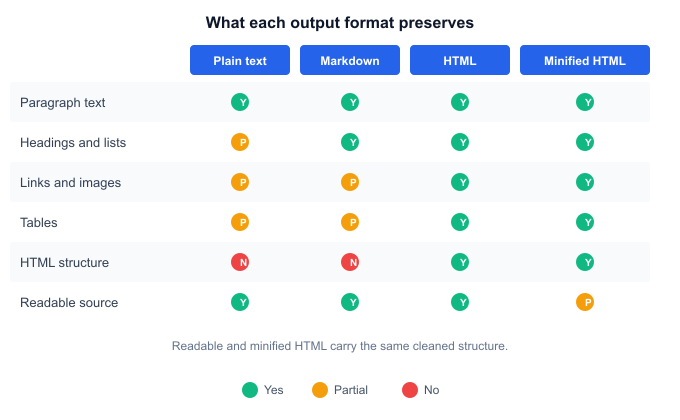 Feature retention by content format
| Representation | Information it carries | What to inspect |
|---|---|---|
| Plain text | Text, paragraph separation, and text representations of lists and tables | Lost link targets, heading levels, and other markup |
| Markdown | Headings, lists, links, code, and supported table syntax | Structures the Markdown dialect cannot express |
| Readable HTML | Cleaned elements and attributes, formatted for inspection | Source size and the downstream rendering boundary |
| Minified HTML | The same cleaned structure with compact presentation | Whitespace-sensitive content and parser expectations |
| Original HTML | The crawler's capture before content extraction | Rendering, parser serialization, and consent changes already applied during capture |
Markdownee's TXT renderer separates table cells with pipes. Its Markdown renderer uses GFM support, including pipe tables. Neither representation retains every HTML feature: a merged-cell table, for example, needs attention after conversion. The Python Trafilatura project's format documentation describes that project's own output choices, which differ from Markdownee's.1
“Original” is a crawler capture, not a byte-exact HTTP archive. It can contain scripts, styles, navigation, and other markup omitted from extracted output. When Markdown discovery supplies the content, the recorded original is derived from that representation.
Count tokens on your own outputs
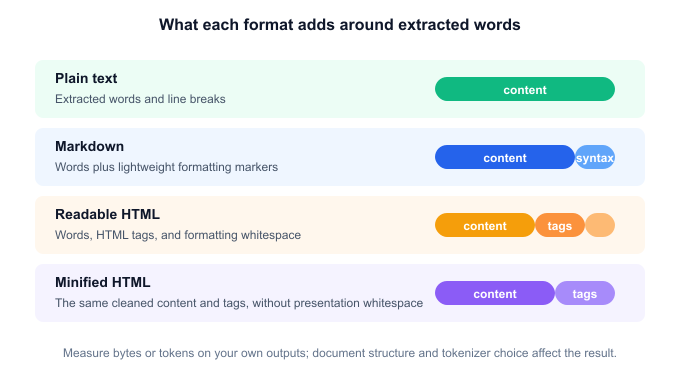 Sources of output overhead by format
Markdown adds syntax such as heading markers and link destinations. HTML adds elements and attributes; minification removes presentation whitespace while retaining that structure. Token counts depend on the tokenizer as well as the bytes, so a byte reduction is not a token benchmark.
Tokenize representative outputs with the model your pipeline uses. Compare source coverage alongside size, then test the downstream retrieval or generation task. Removing a table header may save tokens while making the remaining cells harder to interpret. The conversion guide covers the surrounding preprocessing choices.
Text, Markdown, or HTML for a model
Use plain text when the receiving interface requires it or when your task does not need markup. Classification, text-to-speech, and some indexing pipelines work with this representation. It is a candidate to evaluate for embeddings, not a universal embedding-quality rule.
Use Markdown when headings, lists, links, and code blocks need to remain visible in a text prompt. Keep section context when chunking documents, and check how tables survive. The /llms.txt proposal uses Markdown to describe a site's resources; it is a proposal, not a web standard or proof that Markdown wins every model task.2
Jina's January 2025 ReaderLM evaluation reports ROUGE-L 0.84 for ReaderLM-v2 and 0.86 for its pro checkpoint, versus 0.69 for GPT-4o in that evaluation.3 Those are task- and checkpoint-specific results for producing Markdown from HTML. They do not establish a best format for an unrelated retrieval pipeline.
Use cleaned HTML when element structure matters to the consumer. The HtmlRAG paper evaluates cleaning and pruning retrieved HTML across six question-answering datasets.4 Its results are evidence for that pipeline, not for Markdownee's extraction accuracy. Table 2 reports HotpotQA exact-match scores of 42.25 for HTML, 41.00 for plain text, and 39.00 for Markdown with Llama-3.1-70B. The Natural Questions results differ: 43.65, 44.11, and 42.00 respectively. The format ordering therefore varies by dataset.
For human review, readable HTML supports source inspection and line diffs. For parser input or compact storage, choose Minified HTML. The two presentations can be requested together.
Choose the layout separately
outputLayout determines which metadata surrounds generated content:
minimal, the default, emits TXT/Markdown bodies and HTML fragments.standardadds flat YAML front matter to TXT/Markdown and a generated head in complete HTML documents.enhancedadds further allowlisted page and crawl information.
Standard front matter permits title, author, date, description, and language-code. Enhanced output may also include site-name, page-url, image-url, hostname, categories, tags, license, declared-page-type, request-url, and crawl-* fields. These keys are flat and kebab-case. YAML front matter in TXT is a Markdownee convention, not part of the text/plain standard.
Dataset records retain nested metadata and crawl objects, camelCase names such as siteName and languageCode, and a top-level request URL. Missing optional values and empty optional crawl objects are omitted.
Both HTML presentations use the selected layout. Structured result keys are html and minifiedHtml; selectors and save routes use minified-html. Separate .html and .min.html suffixes distinguish multi-format files. Layout does not modify captured original HTML.
Keep more than one representation when useful
A pipeline can keep Markdown for prompts, readable HTML for inspection, and Minified HTML for storage from one extraction. Save original HTML separately when you need the crawler capture for later analysis.
The source is page HTML by default. Optional Markdown discovery can substitute an accepted origin-published representation, affecting all requested formats. The Markdown guide explains the discovery steps and their request costs.
Citations
-
Trafilatura: Documentation. Retrieved March 27, 2026 ↩
-
Jeremy Howard: The /llms.txt file. Retrieved March 27, 2026 ↩
-
Jina AI: ReaderLM-v2: Frontier Small Language Model for HTML to Markdown and JSON. Retrieved March 27, 2026 ↩
-
Jiejun Tan, Zhicheng Dou, Yutao Zhu, Peidong Guo, Kun Fang, Ji-Rong Wen: HtmlRAG: HTML is Better Than Plain Text for Modeling Retrieved Knowledge in RAG Systems. Proceedings of the ACM Web Conference 2025 ↩
Updated: September 7, 2026